About 344 minutes
Babylonians and Assyrians — Themes and Context
Egypt Near East
79,100 recorded words. 18 minutes difference from this book's estimate.
View Gutenberg source #25080
This digital edition of The Storehouses of the King; Or, the Pyramids of Egypt What They Are and Who Built Them — Key Ideas to Explore is described by source-level measurements including 83,068 words, 6 hr 2 min estimated reading time, and 20 detected text sections.
The text analysis averages about 27.2 words per sentence, while the detected sections provide another way to judge how the source is divided.
Project Gutenberg metadata also associates the work with “Pyramids,” connecting these edition facts with the source record’s subject description.
Explore this collection
These alternatives are selected using recorded categories and estimated reading time.
About 344 minutes
Egypt Near East
79,100 recorded words. 18 minutes difference from this book's estimate.
View Gutenberg source #25080About 452 minutes
Egypt Near East
103,957 recorded words. 90 minutes difference from this book's estimate.
View Gutenberg source #72865About 256 minutes
Egypt Near East
58,657 recorded words. 106 minutes difference from this book's estimate.
View Gutenberg source #27802Search stored excerpts and compare books → Choose by your preferences →
Choices use stored catalog measurements. Estimates vary with reading speed. A shared category is a catalog label, not a claim that two books have the same argument or literary quality.
Search reads excerpt text stored with this catalog and links to its associated Gutenberg record. The connection is stored in the site database; this tool does not recheck that every excerpt is word-for-word identical to that external record. Excerpt search does not cover every chapter and does not verify historical publication dates.
Catalog snapshot checked: 2026-09-26. Coverage: 97 public books, 97 available source excerpts.
Calculated from edition completeness, EPUB availability, text structure and catalogue metadata. Not a user rating.
Total of 100 points, scaled to a 2.5-5.0 range. Editions with an empty description or a missing EPUB file are not scored.
Public-domain source text
The source text is kept in the dedicated reader, separate from this catalogue record and its commentary.
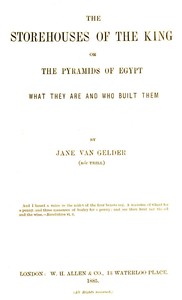
Jane van Gelder opens The Storehouses of the King with a bold claim: the pyramids of Egypt were not tombs but granaries, built to store grain during the seven years of plenty described in the biblical story of Joseph. The epigraph from Revelation 6:6—'A measure of wheat for a penny'—signals her interpretive lens from the start. In the preface, she recounts making her discovery in August 1880 while reading the latest works on pyramids, recognizing features in the Great Pyramid's interior that matched known storehouse designs. She writes that 'the vexed question may be set at rest' and dedicates the volume to 'Egyptologists and Freemasons of all nations.' The book thus positions itself as a solution to a long-standing mystery, blending scriptural authority with architectural observation.
Van Gelder does not claim to have excavated or visited Egypt. Her discovery is textual: she recognized 'some features in the interior of the Great Pyramid' while reading other scholars' works. The preface describes a process of careful comparison—'reading more carefully every book, and examining all the illustrations'—until doubt was removed. This method sets the tone for a work that argues through reinterpretation of existing evidence rather than new fieldwork. The author's emotional response—'the sensation after the removal of doubt was painful'—adds a personal, almost confessional layer to the scholarly argument. Readers should note that van Gelder's evidence is entirely secondhand, drawn from published accounts and images.
The book's title and epigraph frame the pyramids as 'storehouses of the king,' directly linking them to the biblical narrative of Joseph storing grain in Egypt. Van Gelder uses Revelation 6:6 to suggest that the pyramids' purpose was prophesied. This approach places her work in a tradition of scriptural archaeology that reads ancient monuments through biblical texts. The preface mentions that the discovery was made 'whilst reading the latest works on the Pyramids,' implying that modern scholarship had overlooked a simple truth. Readers should be aware that van Gelder's argument depends on accepting the Bible as a historical source for Egyptian events, a position that was already contested in 1885.
The excerpts show that van Gelder organizes her book around a single thesis, but the later sections—such as the digression on Mexican picture-writing—suggest a broader comparative approach. She discusses how Mexican manuscripts were preserved and transmitted, including the role of figures like Hakluyt and Purchas. This material appears to support her argument about the preservation of ancient records, though the connection to pyramids is not explicit in the excerpts. The book's structure moves from the discovery narrative to historical evidence, then to comparative examples. Readers may find the Mexican section tangential, but it reflects van Gelder's interest in how ancient knowledge survives through copying and translation.
Van Gelder's dedication to 'Egyptologists and Freemasons of all nations' hints at the audience she hoped to reach. In 1885, the dominant theory held that pyramids were royal tombs, and alternative explanations (astronomical, symbolic) were marginal. By asserting a practical, biblical function, van Gelder positioned herself against the academic consensus. Her tone is confident—'the solution to the mystery has been found'—but the excerpts do not reveal how she addresses counterarguments. The book's reliance on textual reinterpretation rather than new data likely limited its impact on mainstream Egyptology. Modern readers should approach it as a document of Victorian amateur scholarship, valuable for its insight into how non-specialists engaged with ancient history.
Van Gelder's work rewards readers who enjoy following a single, unorthodox argument pursued with conviction. The book's value lies less in its conclusions than in its method: a close reading of published sources, a willingness to challenge established views, and an integration of biblical prophecy with architectural detail. Readers should treat the Mexican digression as a window into van Gelder's broader interests in ancient record-keeping. For those curious about how Victorian amateurs approached Egyptology, The Storehouses of the King offers a distinctive, passionately argued perspective.
I keep thinking about van Gelder's strange certainty that the pyramids held grain, not kings. It made me wonder what else we've misread in stone. Then I found Ten years' digging in Egypt, 1881-1891 — Text and Context, and it felt like sitting beside someone who'd actually touched those walls, quietly correcting our assumptions. That lingering ache of being proven wrong, gently.
Save your reaction, strongest insight, and memorable passage.