About 362 minutes
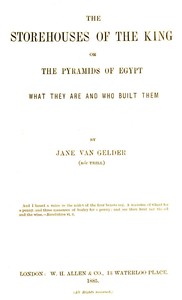
The Storehouses of the King; Or, the Pyramids of Egypt What They Are and Who Built Them — Key Ideas to Explore
Egypt Near East
83,068 recorded words. 90 minutes difference from this book's estimate.
View Gutenberg source #47291
The glory of the Pharaohs — Reading Companion can be approached with a clearer sense of reading commitment from its source measurements: 103,957 words, 7 hr 32 min estimated reading time, and 12 detected text sections.
The text analysis averages about 29.3 words per sentence, while the detected sections provide another way to judge how the source is divided.
Project Gutenberg metadata also associates the work with “Egypt -- Antiquities,” connecting these edition facts with the source record’s subject description.
Explore this collection
These alternatives are selected using recorded categories and estimated reading time.
About 362 minutes
Egypt Near East
83,068 recorded words. 90 minutes difference from this book's estimate.
View Gutenberg source #47291About 344 minutes
Egypt Near East
79,100 recorded words. 108 minutes difference from this book's estimate.
View Gutenberg source #25080About 577 minutes
Egypt Near East
132,574 recorded words. 125 minutes difference from this book's estimate.
View Gutenberg source #45229Search stored excerpts and compare books → Choose by your preferences →
Choices use stored catalog measurements. Estimates vary with reading speed. A shared category is a catalog label, not a claim that two books have the same argument or literary quality.
Search reads excerpt text stored with this catalog and links to its associated Gutenberg record. The connection is stored in the site database; this tool does not recheck that every excerpt is word-for-word identical to that external record. Excerpt search does not cover every chapter and does not verify historical publication dates.
Catalog snapshot checked: 2026-09-26. Coverage: 97 public books, 97 available source excerpts.
Calculated from edition completeness, EPUB availability, text structure and catalogue metadata. Not a user rating.
Total of 100 points, scaled to a 2.5-5.0 range. Editions with an empty description or a missing EPUB file are not scored.
Public-domain source text
The source text is kept in the dedicated reader, separate from this catalogue record and its commentary.
Arthur Weigall, who served as Inspector General of Antiquities for Upper Egypt from 1904 to 1914, writes from a position of direct involvement in the excavations he describes. His account of discovering Akhnaton's tomb in 1907 is not a dry report but a narrative that intertwines physical evidence—such as the seal of Tutankhamon found blocking the entrance—with interpretive speculation about the heretic king's final days. The excerpts reveal a writer who shifts between meticulous description of artifacts (alabaster vases, gold vulture, canopic jars) and empathetic conjecture about Akhnaton's despondency as his religious revolution collapsed.
Weigall's professional credentials are not merely listed in the front matter; they shape the prose. He supervised excavations in the Valley of the Tombs of the Kings and was present at major discoveries. In the excerpt, he describes finding the tomb of Akhnaton in 1907, noting that the entrance was blocked with stones and sealed with a fragment of Tutankhamon's seal. This detail is not presented as secondhand knowledge but as something he personally observed. The publisher's foreword emphasizes his reforms in preserving antiquities and suppressing illegal excavation, lending weight to his observations. When he writes that the body in the tomb was Akhnaton's, not Queen Tiy's, he is correcting earlier Egyptological assumptions based on his own findings.
Weigall does not limit himself to cataloging objects. He reconstructs emotional states: Akhnaton, he writes, “must have felt that his religion could not outlive him” and “sunk to the very depths of despondency.” The author wonders whether the pharaoh found “consolation in the sunshine and amidst the flowers.” This speculative, almost novelistic tone is balanced by concrete evidence—the erasure of Akhnaton's name from inscriptions, the removal of Queen Tiy's body, the abandonment of the city. Weigall interprets the physical traces as signs of a deliberate campaign to erase the heretic from memory, culminating in the tomb being “polluted by the presence of the heretic.” The reader is given both the archaeological data and a plausible human narrative.
Weigall's prose is characterized by direct address and vivid phrasing. He refers to Akhnaton as “that criminal” (quoting the later priesthood's view) and describes the fallen city as “the haunt of jackals and the home of owls.” The language is accessible yet precise, avoiding the dry catalog style of many contemporary reports. The excerpts show a writer who can shift from technical description—the “canopic jars, the alabaster vases, the gold vulture”—to lyrical quotation, as when he includes Akhnaton's prayer: “I shall breathe the sweet breath which comes forth from Thy mouth.” This blending of scientific observation and literary sensibility gives the work a distinctive character, one that reflects Weigall's dual identity as both a trained Egyptologist and a popular author.
Readers approaching this work should expect a series of essays that combine personal recollection with historical interpretation. Weigall's authority as a former Inspector General of Antiquities means his observations carry weight, but his willingness to speculate about motives and emotions means the book is as much a narrative as a scholarly account. The excerpts suggest that the full volume covers a range of topics beyond Akhnaton, but the same blend of evidence and empathy likely persists throughout.
That rainy afternoon, Weigall’s account of Akhnaton’s tomb left me restless, the sand and politics still clinging. I wanted something simpler, sturdier—and found myself wandering into The Storehouses of the King; Or, the Pyramids of Egypt What They Are and Who Built Them — Key Ideas to Explore. The same stones, but a quieter question: not who was buried, but who bothered to lift them.
Your answers remain private and are stored only in this browser.