The Rosetta Stone — Reading Notes

(0 User reviews)   1104
In Category - Egypt Near East
Budge, E. A. Wallis (Ernest Alfred Wallis), Sir, 1857-1934 Project Gutenberg 2015 Not confirmed
Rosetta stone; Egyptian language -- Writing, Hieroglyphic Readers of public-domain and historical texts
Project Gutenberg digital edition en

Edition facts

Words 7,132
Reading time 32 min
Text sections 1

This digital edition of The Rosetta Stone — Reading Notes is described by source-level measurements including 7,132 words, 32 min estimated reading time, and 1 detected text section.

The text analysis averages about 24.3 words per sentence, while the detected sections provide another way to judge how the source is divided.

Project Gutenberg metadata also associates the work with “Rosetta stone,” connecting these edition facts with the source record’s subject description.

Explore this collection

Compare your next read

These alternatives are selected using recorded categories and estimated reading time.

Search stored excerpts and compare books → Choose by your preferences →

How these choices and excerpts are prepared

Choices use stored catalog measurements. Estimates vary with reading speed. A shared category is a catalog label, not a claim that two books have the same argument or literary quality.

Search reads excerpt text stored with this catalog and links to its associated Gutenberg record. The connection is stored in the site database; this tool does not recheck that every excerpt is word-for-word identical to that external record. Excerpt search does not cover every chapter and does not verify historical publication dates.

Catalog snapshot checked: 2026-09-26. Coverage: 97 public books, 97 available source excerpts.

Budge's 1913 guide to the Rosetta Stone details its discovery by French soldiers, decipherment by Champollion, and the text of the Ptolemaic decree. The catalog subjects focus on the stone and hieroglyphic writing, but the excerpts emphasize the stone's modern history and the decree's political content.
Share
Editorial Edition Score 4.3/5

Calculated from edition completeness, EPUB availability, text structure and catalogue metadata. Not a user rating.

How this score is calculated
  • Description quality20 pts
  • Title & short description10 pts
  • Source metadata20 pts
  • Text length15 pts
  • Chapters / structure15 pts
  • EPUB file integrity20 pts

Total of 100 points, scaled to a 2.5-5.0 range. Editions with an empty description or a missing EPUB file are not scored.

Edition quality

Public-domain source text

Read the source text

The source text is kept in the dedicated reader, separate from this catalogue record and its commentary.

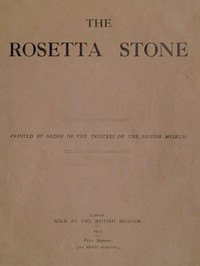
E. A. Wallis Budge's 1913 booklet, published by order of the Trustees of the British Museum, opens not with the stone's ancient inscription but with its modern discovery: a French officer named Boussard (or Bouchard) found it in August 1799 while demolishing a wall near Rosetta. The stone was initially treated as General Menou's private property before Napoleon ordered it to Cairo. Budge's account foregrounds the stone's journey through European hands—French, then British—rather than its Egyptian origins. The catalog subjects list 'Rosetta stone' and 'Egyptian language -- Writing, Hieroglyphic,' but the excerpts devote more space to the stone's capture and transport than to the mechanics of decipherment.

Discovery and Early Ownership

Budge recounts two conflicting accounts of the stone's discovery: one says it lay on the ground, another that it was built into a wall. He names the finder as a French officer of engineers, spelling his name both Boussard and Bouchard, and notes he later became a general. The stone was taken to General Menou's house in Alexandria, where it remained for two years as private property. Napoleon then ordered it to Cairo's Institut National. Budge emphasizes the French effort to distribute copies: two lithographers, 'citizens Marcel and Galland,' made ink impressions by rolling paper over the inked stone. These were sent to scholars across Europe. The narrative then shifts to the stone's seizure by British forces after Abercromby's campaign, a transition that occupies several paragraphs.

Decipherment and Champollion's Method

Budge's explanation of decipherment is brief and technical. He shows how Champollion compared variant signs, using the name Ptah as an example: the hieroglyphs for Ptah on the Rosetta Stone are a variant of another form, and by comparing texts and using Coptic, Champollion deduced that one sign group equals 'mer.' Budge states that Champollion 'succeeded in formulating the system of decipherment of Egyptian hieroglyphs that is, substantially, that in use at the present day.' The excerpts do not detail the process further; instead, they move quickly to the inscription's contents. The catalog subject 'Egyptian language -- Writing, Hieroglyphic' is thus addressed only in a condensed passage, leaving the reader wanting more on the actual mechanics of the breakthrough.

The Decree's Political and Economic Provisions

The inscription is a decree of the General Council of Egyptian priests at Memphis, celebrating the first commemoration of Ptolemy V's coronation in 196 BC. Budge lists eighteen benefits the king conferred, including gifts to temples, remission of taxes, forgiveness of debts, release of prisoners, and abolition of the press-gang for sailors. The priests responded by ordering statues of Ptolemy as 'Saviour of Egypt' in every temple, gold shrines to be carried in procession, and annual festivals on his birthday and coronation days. The decree also added a new priestly title. Budge's list format—numbered items—makes the political transaction explicit: the stone records a quid pro quo between the king and the priesthood, a fact that the catalog subjects do not capture.

Budge's booklet, though titled after the stone, is as much about the politics of antiquities collection as about hieroglyphic writing. Readers should note that the excerpts break off before the full text of the decree is given; the surviving portions emphasize the stone's modern history and the decree's list of benefits. For those interested in the decipherment itself, the text offers only a summary. The stone's role as a document of Ptolemaic statecraft, rather than a key to Egyptian language, is the more fully developed theme in the available pages.

Holding Budge’s account of the Rosetta Stone, I thought of sitting in my grandfather’s study, turning pages of Mesopotamian Archaeology An introduction to the archaeology of Mesopotamia and Assyria — A Reader’s Guide. Both books feel like quiet doorways—not to grand discoveries, but to the patient hands that brushed away dust. That same hush, that same awe.

There are no reviews for this eBook.

0
0 out of 5 (0 User reviews )

Add a Review

Your Rating *
There are no comments for this eBook.

Reader reflection

How will you remember this book?

Save your reaction, strongest insight, and memorable passage.

Your progress 0 / 10
1

How far have you progressed with this book?

2

Was reading this book enjoyable?

3

Would you pass this book on to a friend?

4

What was the reading difficulty like?

Related eBooks