About 291 minutes
The New Stone Age in Northern Europe — Reading Companion
Ancient Civilizations
66,782 recorded words. 3 minutes difference from this book's estimate.
View Gutenberg source #41649
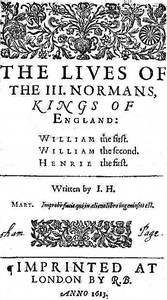
The Lives of the III. Normans, Kings of England: William the First, William the Second, Henrie the First — Text and Context can be approached with a clearer sense of reading commitment from its source measurements: 66,097 words, 4 hr 48 min estimated reading time, and 7 detected text sections.
The text analysis averages about 29.9 words per sentence, while the detected sections provide another way to judge how the source is divided.
Project Gutenberg metadata also associates the work with “Great Britain -- History,” connecting these edition facts with the source record’s subject description.
Explore this collection
These alternatives are selected using recorded categories and estimated reading time.
About 291 minutes
Ancient Civilizations
66,782 recorded words. 3 minutes difference from this book's estimate.
View Gutenberg source #41649About 296 minutes
Ancient Civilizations
67,953 recorded words. 8 minutes difference from this book's estimate.
View Gutenberg source #60770About 270 minutes
Ancient Civilizations
62,033 recorded words. 18 minutes difference from this book's estimate.
View Gutenberg source #57288Search stored excerpts and compare books → Choose by your preferences →
Choices use stored catalog measurements. Estimates vary with reading speed. A shared category is a catalog label, not a claim that two books have the same argument or literary quality.
Search reads excerpt text stored with this catalog and links to its associated Gutenberg record. The connection is stored in the site database; this tool does not recheck that every excerpt is word-for-word identical to that external record. Excerpt search does not cover every chapter and does not verify historical publication dates.
Catalog snapshot checked: 2026-09-26. Coverage: 97 public books, 97 available source excerpts.
Calculated from edition completeness, EPUB availability, text structure and catalogue metadata. Not a user rating.
Total of 100 points, scaled to a 2.5-5.0 range. Editions with an empty description or a missing EPUB file are not scored.
Public-domain source text
The source text is kept in the dedicated reader, separate from this catalogue record and its commentary.
John Hayward's The Lives of the III. Normans, Kings of England (1613) opens with a dedication to Prince Charles that frames the work as a response to a complaint by the late Prince Henry about the neglect of English history. Hayward's prose is immediately distinctive: he employs a Senecan, aphoristic style, as when he notes that 'an vnperfect victory is alwayes the seede of a new warre.' The narrative voice is both learned and pointed, mixing moral reflection with tactical detail.
The text moves between rapid, almost breathless accounts of military campaigns—sieges, pursuits, and naval engagements—and slower, more deliberative passages where Hayward weighs the motives of his subjects. This alternation in pace is one of the work's most striking features, giving the reader a sense of both the chaos of events and the order of retrospective judgment.
Hayward frequently interrupts his narrative with sententiae that condense political wisdom into memorable phrases. For instance, he observes that 'pardon neuer sufficeth to assure offenders, vnlesse by further benefits their loyaltie bee bound.' These maxims serve a dual purpose: they reveal Hayward's humanist training and they guide the reader's interpretation of events. The moral framework is explicit—characters are praised for 'mild moderation' or 'simple sanctitie' and condemned for ambition or delay.
This style is not merely decorative; it shapes the pacing of the narrative. After a dense passage of military action, Hayward often pauses to deliver a general reflection, creating a rhythm of event and commentary. The effect is to elevate the chronicle from mere report to a kind of political philosophy in action.
The accounts of battles and sieges in The Lives are marked by a distinctive alternation between swift, summary action and detailed tactical exposition. In the rebellion against William II, Hayward describes how 'the King in person led his chiefe forces in to Kent' and quickly captures castles, but then slows to explain the role of Lanfranc and Woolstane in securing loyalty. The siege of Rochester is given in a single sentence, while the aftermath—the flight of the Bishop of Durham and the submission of rebels—receives fuller treatment.
This variation in pace reflects Hayward's interest in the causes and consequences of events, not just their occurrence. He lingers on moments of decision and delay, as when Robert of Normandy 'had good leisure, to looke into the errour of his leisurely proceedings.' The narrative tempo thus becomes a tool for moral and strategic analysis.
Hayward's narrator is a constant presence, shaping the reader's response through direct commentary and carefully chosen adjectives. He describes Odo as 'the principall firebrand of all this flame,' a vivid metaphor that colors the account of the rebellion. The narrator also offers judgments on the effectiveness of actions: William II's 'fortunate celeritie' is contrasted with Robert's 'negligence' and 'delayes.'
This authoritative voice is established early in the dedication, where Hayward recounts his conversation with Prince Henry about the dangers of writing history. The narrator presents himself as a cautious but principled historian, aware that 'men might safely write of others in a tale, but in maner of a History, safely they could not.' This self-awareness adds a layer of complexity to the narrative, as the reader is reminded that the text is itself a political act.
Readers approaching Hayward's Lives will benefit from attending to the shifts in narrative pace—from swift military action to reflective moral commentary—as these reveal the author's humanist method. The work rewards careful reading of its aphorisms and its narrator's judgments, which together create a portrait of Norman kingship that is both vivid and analytical. Hayward's prose, with its Senecan cadences and pointed observations, offers a window into early modern historical writing at its most engaged.
Reading Hayward's Normans, I kept thinking how the battle-thunder gives way to those quiet, deliberative stretches—the same rhythm I find in flipping through An Introduction to the History of Science — Key Ideas to Explore lately, where discovery pauses for a breath, then resumes, like old stone halls holding their centuries of patience. An Introduction to the History of Science — Key Ideas to Explore sits beside my chair now, a companion for slow afternoons.
Use these questions to collect your thoughts before moving on.