About 291 minutes
The New Stone Age in Northern Europe — Reading Companion
Ancient Civilizations
66,782 recorded words. 5 minutes difference from this book's estimate.
View Gutenberg source #41649
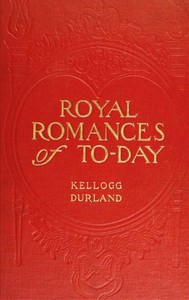
For Royal Romances of To-day — Reading Companion, the stored edition analysis reports 67,953 words, 4 hr 56 min estimated reading time, and 8 detected text sections.
The text analysis averages about 23.3 words per sentence, while the detected sections provide another way to judge how the source is divided.
Project Gutenberg metadata also associates the work with “Kings and rulers,” connecting these edition facts with the source record’s subject description.
Explore this collection
These alternatives are selected using recorded categories and estimated reading time.
About 291 minutes
Ancient Civilizations
66,782 recorded words. 5 minutes difference from this book's estimate.
View Gutenberg source #41649About 288 minutes
Ancient Civilizations
66,097 recorded words. 8 minutes difference from this book's estimate.
View Gutenberg source #38513About 307 minutes
Ancient Civilizations
70,499 recorded words. 11 minutes difference from this book's estimate.
View Gutenberg source #42419Search stored excerpts and compare books → Choose by your preferences →
Choices use stored catalog measurements. Estimates vary with reading speed. A shared category is a catalog label, not a claim that two books have the same argument or literary quality.
Search reads excerpt text stored with this catalog and links to its associated Gutenberg record. The connection is stored in the site database; this tool does not recheck that every excerpt is word-for-word identical to that external record. Excerpt search does not cover every chapter and does not verify historical publication dates.
Catalog snapshot checked: 2026-09-26. Coverage: 97 public books, 97 available source excerpts.
Calculated from edition completeness, EPUB availability, text structure and catalogue metadata. Not a user rating.
Total of 100 points, scaled to a 2.5-5.0 range. Editions with an empty description or a missing EPUB file are not scored.
Public-domain source text
The source text is kept in the dedicated reader, separate from this catalogue record and its commentary.
Durland opens with a friend's remark that good queens, like good women, have no history—then sets out to prove otherwise by focusing on the private lives of three reigning consorts. The foreword reveals that the chapters originated as magazine assignments for the Woman's Home Companion, sending Durland to Russia in 1907 and Italy in 1908. This journalistic origin shapes the book's intimate tone: the author positions himself as a chronicler of romance rather than statecraft, dwelling on courtships, motherhood, and domestic routines.
The excerpts show a consistent emphasis on the queens as wives and mothers first. Of Alexandra, Durland writes that her life has been 'one long romance' and that she gave herself to Nicholas, not to Russia. This framing—personal devotion over public duty—recurs across all three profiles and defines the book's approach to royal biography.
The book's origin in commissioned magazine articles gives it a particular texture. Durland traveled to Russia and Italy specifically to gather material, and the text carries traces of direct observation and interview. The foreword mentions that the Woman's Home Companion sent him to write 'the story of the early days, courtship and marriage' of the Tsaritsa, and a similar assignment for Queen Elena followed. This explains the wealth of domestic detail—descriptions of nurseries, children at play, and family routines—that a purely archival study might lack.
Readers should note that Durland's access was likely mediated by court officials and approved sources. The tone is uniformly admiring, and no critical voices appear. The book presents itself as an authorized or at least sympathetic portrait, which shapes every anecdote and characterization.
The longest excerpt concerns Alexandra Feodorovna, and it reveals Durland's fascination with her spiritual life. He traces her interest in mysticism and spiritualism to her ancestors' belief in ghosts, and devotes a chapter to 'Spirit Whisperings.' The description of her face—'unusual other-worldly beauty' with lines of 'wistful pathos'—links her appearance to 'soul development' and religious contemplation.
Durland explicitly states that Alexandra's life as Empress must be passed over lightly in favor of her roles as wife and mother. This choice is ideological: he argues that her devotion to Nicholas, not to the nation, defines her. The reader watches Durland balance admiration for her personal qualities with an implicit acknowledgment that this private focus may have had political costs.
A striking passage enumerates the Tsaritsa's household: nearly thirty thousand servants, fifty thousand head of cattle, five thousand horses. Durland notes that this vast retinue is 'divided into groups and officered by various functionaries,' much like an army. The Tsaritsa's word, spoken to a lady-in-waiting, suffices to command this host.
These details serve a dual purpose. They establish the immense power and wealth of the Russian court—the Tsar's private income from Siberian mines and timber, plus a government salary of nearly five million dollars a year. Yet they also reinforce Durland's central argument: that Alexandra chose the 'quieter life of the home' despite this scale of power. The contrast between her resources and her domestic focus is the book's recurring theme.
The table of contents shows that each of the three parts follows a similar arc: courtship, wedding, motherhood, and a chapter on the queen's character or public role. Queen Elena's section includes 'The Heroism of Queen Elena' and 'Simplicity of the Italian Court,' while Victoria Eugenie's covers 'A Baptism of Blood' and 'Winning a Nation's Love.' The structure suggests Durland saw these lives as parallel romances, each illustrating the same ideal of royal womanhood.
Readers should be alert to this template. The book does not offer three independent biographies so much as three variations on a theme. The evidence for each queen's personality is filtered through Durland's consistent lens: that a good queen's true history is her family life. The excerpts do not reveal whether the queens themselves would have agreed with this framing.
Durland's book is best approached as a period piece of royal journalism, written at the height of the European monarchies just before World War I. The three profiles share a structure and a thesis: that these queens' significance lies in their domestic devotion, not their political influence. Readers interested in the gap between public image and private reality, or in the conventions of early twentieth-century biographical writing, will find rich material here. The excerpts offer a consistent voice but an incomplete picture—each queen's story is told from a single, admiring angle.
There’s a particular tenderness in those old royal profiles—queens shown mostly as wives and mothers, their crowns almost an afterthought. It reminded me, oddly, of how we once imagined history as a simple family story. That same quiet wonder follows me into The Discovery of America by the Northmen, 985-1015 — Context and Discussion, where discovery feels less like conquest and more like a careful, homesick voyage.
Save your reaction, strongest insight, and memorable passage.