About 1,716 minutes
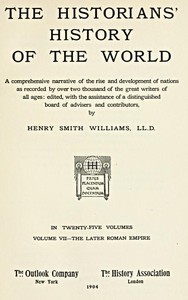
The historians' history of the world in twenty-five volumes, volume 07 — Story, Setting & Ideas
Rome
394,589 recorded words. 34 minutes difference from this book's estimate.
View Gutenberg source #59134
This digital edition of The historians' history of the world in twenty-five volumes, volume 06 — Edition Insights is described by source-level measurements including 402,297 words, 29 hr 10 min estimated reading time, and 50 detected text sections.
The text analysis averages about 27.6 words per sentence, while the detected sections provide another way to judge how the source is divided.
Project Gutenberg metadata also associates the work with “World history,” connecting these edition facts with the source record’s subject description.
Explore this collection
These alternatives are selected using recorded categories and estimated reading time.
About 1,716 minutes
Rome
394,589 recorded words. 34 minutes difference from this book's estimate.
View Gutenberg source #59134About 884 minutes
Rome
203,109 recorded words. 866 minutes difference from this book's estimate.
View Gutenberg source #6839About 634 minutes
Rome
145,622 recorded words. 1116 minutes difference from this book's estimate.
View Gutenberg source #67095Search stored excerpts and compare books → Choose by your preferences →
Choices use stored catalog measurements. Estimates vary with reading speed. A shared category is a catalog label, not a claim that two books have the same argument or literary quality.
Search reads excerpt text stored with this catalog and links to its associated Gutenberg record. The connection is stored in the site database; this tool does not recheck that every excerpt is word-for-word identical to that external record. Excerpt search does not cover every chapter and does not verify historical publication dates.
Catalog snapshot checked: 2026-09-26. Coverage: 97 public books, 97 available source excerpts.
Calculated from edition completeness, EPUB availability, text structure and catalogue metadata. Not a user rating.
Total of 100 points, scaled to a 2.5-5.0 range. Editions with an empty description or a missing EPUB file are not scored.
Public-domain source text
The source text is kept in the dedicated reader, separate from this catalogue record and its commentary.
Volume VI of The Historians' History of the World opens with a sketch by Otto Hirschfeld and then moves through chapters that alternate between imperial administration and military narrative. The editor, Henry Smith Williams, structures the volume around thematic blocks: the empire's provinces, the German wars, and the material culture of Roman reading. A striking feature is the shift from broad policy—Augustus making Egypt his private province—to the visceral detail of the Teutoburg Forest, where gruesome relics are mentioned. This juxtaposition of administrative order and battlefield chaos recurs throughout the excerpts.
The volume’s arrangement moves between two poles: the organization of imperial rule and the disorder of frontier conflict. Chapter XXIX details Augustus’s provincial reforms, including the army and navy, while Chapter XXX plunges into the German War of Independence and the battle of Teutoburg Forest. The editor does not blend these topics; instead, he presents them as discrete blocks, allowing the reader to contrast the logic of administration with the chaos of combat. The excerpts show that the narrative shifts abruptly from the allocation of provinces to the description of Germanicus’s campaigns, with no transitional commentary. This structure emphasizes the empire’s dual nature: a machine of governance and a theater of violence.
A recurring image in the later portion of the volume is the physical book—its production, storage, and social role. The text describes papyrus rolls arranged transversely, tags projecting from cases in Pompeian paintings, and the practice of writing an entire work on a single strip. The editor lingers on the scale of Roman book culture: the grammarian Epaphroditus owned thirty thousand volumes, and Sammanicus Serenus had sixty-two thousand. Augustus confiscated two thousand copies of the pseudo-sibylline oracles, a detail that ties book collecting to imperial power. The passage also notes that public libraries numbered at least twenty-nine in Rome, with the Ulpian library of Trajan being the most famous. These details form a visual motif of scrolls, shelves, and labels that recurs across the excerpts.
The volume frequently shifts between public institutions and private collections. Asinius Pollio is credited with founding the first public library, yet the text immediately notes that private libraries could rival imperial ones. The editor moves from the public libraries of Augustus (the Octavian and Palatine) to the private library of Epaphroditus, then to the confiscation of oracles by the emperor. This back-and-forth creates a sense of circulation: books moved from private hands to public shelves, and from authors to readers. The excerpt also mentions that bookstores advertised authors on pillars outside shops, blending commercial and intellectual life. The movement is not linear but oscillating, mirroring the volume’s own alternation between administrative and military topics.
Williams compiles excerpts from multiple historians, but the volume’s voice is shaped by his editorial choices. The excerpts show that he includes a sketch by Otto Hirschfeld, then chapters that mix narrative with lists (e.g., provinces, army organization). The text on book culture appears to be a synthesis, not a single source, as it cites Publius Victor, Seneca, and Cicero. The editor also inserts a transcriber’s note about mismatched reference letters, acknowledging the original’s flaws. This self-awareness about the source material is rare in the excerpts. The volume thus presents itself as a constructed work, not a seamless chronicle, and the reader is reminded that the history is mediated through editors and scribes.
Readers approaching this volume should attend to its structural seams: the abrupt transitions between provincial administration and military narrative, and the recurring image of the book as both object and symbol. The editor’s arrangement rewards those who move between chapters, comparing the order of the empire with the disorder of its frontiers. The volume’s final section on libraries offers a quiet counterpoint to the earlier battles, suggesting that the empire’s legacy was also one of reading and collecting.
Volume six's editorial hand lingers over imperial routines, and I remembered sitting with my grandfather, who loved how Cicero's letters made Rome feel like a house with open doors. Social life at Rome in the Age of Cicero — Key Ideas to Explore once gave me that same hush—not history marching, but people murmuring over dinner, waiting for news that never quite arrived.
Save your reaction, strongest insight, and memorable passage.