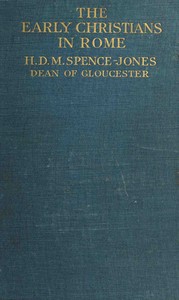
The Early Christians in Rome — Inside the Classic

(0 User reviews)   953
In Category - Rome
Spence-Jones, H. D. M. (Henry Donald Maurice), 1836-1917 Project Gutenberg 2022 Not confirmed
Church history -- Primitive and early church, ca. 30-600; Rome (Italy) -- Church history Readers of public-domain and historical texts
Project Gutenberg digital edition en

Edition facts

Words 145,622
Reading time 634 min
Text sections 50

Before opening The Early Christians in Rome — Inside the Classic, the edition data offers a quick orientation: 145,622 words, 10 hr 34 min estimated reading time, and 50 detected text sections.

The text analysis averages about 23.1 words per sentence, while the detected sections provide another way to judge how the source is divided.

Project Gutenberg metadata also associates the work with “Church history -- Primitive and early church, ca. 30-600,” connecting these edition facts with the source record’s subject description.

Explore this collection

Compare your next read

These alternatives are selected using recorded categories and estimated reading time.

Search stored excerpts and compare books → Choose by your preferences →

How these choices and excerpts are prepared

Choices use stored catalog measurements. Estimates vary with reading speed. A shared category is a catalog label, not a claim that two books have the same argument or literary quality.

Search reads excerpt text stored with this catalog and links to its associated Gutenberg record. The connection is stored in the site database; this tool does not recheck that every excerpt is word-for-word identical to that external record. Excerpt search does not cover every chapter and does not verify historical publication dates.

Catalog snapshot checked: 2026-09-26. Coverage: 97 public books, 97 available source excerpts.

This editorial note examines how Spence-Jones structures his study of early Roman Christianity through the opening, middle, and later excerpts, focusing on his use of archaeological evidence, catacomb exploration, and the transition from narrative history to detailed cemetery descriptions.
Share
Editorial Edition Score 4.9/5

Calculated from edition completeness, EPUB availability, text structure and catalogue metadata. Not a user rating.

How this score is calculated
  • Description quality20 pts
  • Title & short description10 pts
  • Source metadata20 pts
  • Text length15 pts
  • Chapters / structure15 pts
  • EPUB file integrity20 pts

Total of 100 points, scaled to a 2.5-5.0 range. Editions with an empty description or a missing EPUB file are not scored.

Edition quality

Public-domain source text

Read the source text

The source text is kept in the dedicated reader, separate from this catalogue record and its commentary.

Spence-Jones opens The Early Christians in Rome with a preface that immediately establishes the work's dual focus: the historical fortunes of the Roman church and the foundational roles of Peter and Paul. He notes that Peter was 'the first apostle who preached in Rome' and that Paul's teaching 'supplemented and explained in detail' Peter's. The preface then traces persecution from Nero through the Flavians, Nerva, Trajan, and Hadrian, ending with Constantine's edict of 313. This chronological sweep sets up the book's five-part structure, though the excerpts provided do not reveal the full contents of each book.

From Narrative to Archaeology

The middle excerpts shift sharply from historical narrative to archaeological description. Spence-Jones introduces the work of De Rossi and his followers, who 'threw a flood of light' on the Diocletian persecution and identified tombs of martyrs and bishops. He quotes Marucchi on 'a very glorious group of monuments' and notes that 'innumerable crypts are still waiting to be explored.' This section reveals the author's reliance on contemporary scholarship and his interest in the material remains of early Christianity, not just textual sources.

The Catacombs as a City of the Dead

Spence-Jones then presents a systematic survey of Roman cemeteries, organizing them by the public roads leading out of Rome. He describes the Vatican Hill cemetery, which includes the tomb of Peter, and notes that Anacletus erected a 'Memoria' or little chapel over the apostle's tomb, which later grew into the basilica of St. Peter's. The author emphasizes that around Peter's tomb were buried 'the nine or ten first Bishops or Popes of Rome' and other nameless saints. This archaeological tour grounds the earlier historical claims in physical locations.

Voice and Scholarly Apparatus

Throughout the excerpts, Spence-Jones maintains a formal, scholarly tone. He uses footnotes (indicated by bracketed numbers like [1] and [124]) and references to contemporary scholars such as De Rossi and Marucchi. The preface and later sections show a careful balance between narrative history and descriptive archaeology. The author does not claim definitive knowledge but presents evidence from excavations and pilgrim itineraries, noting where identification is uncertain. This cautious approach lends credibility to his account.

Reading the Excerpts as a Guide

The excerpts progress from a broad historical overview to a focused archaeological survey. A first-time reader should note that the preface provides the chronological framework, while the later sections offer concrete details about specific sites. The author's emphasis on the catacombs as a 'subterranean City of the Dead' and his enumeration of thirty-seven cemeteries indicate that the work is as much about physical remains as about written history. Readers interested in the material culture of early Christianity will find the later excerpts particularly valuable.

Spence-Jones's work is best approached as a hybrid of history and archaeology. The excerpts suggest that the full book likely alternates between narrative chapters on persecution and detailed descriptions of catacombs and tombs. Readers should pay attention to the footnotes and references to De Rossi, as these indicate the author's reliance on pioneering archaeological research. The book's value lies in its synthesis of textual and material evidence, offering a comprehensive view of early Christian Rome.

When Spence-Jones leads us down into the Roman catacombs, past the hush of lamplit corridors, I think often of that other, sunlit city, the one Cicero knew. There, too, lives a particular quiet—the murmur of a Republic before its storm. Both books share that patient ear for what whispers beneath history’s noise, a kinship I have come to cherish like an old friend. Roman life in the days of Cicero — A Closer Reading rests beside it on my shelf, two lamps in the same long dusk.

There are no reviews for this eBook.

0
0 out of 5 (0 User reviews )

Add a Review

Your Rating *
There are no comments for this eBook.

Reader reflection

What did you think of this book?

Answer a few questions and save a private reflection on this device.

Your progress 0 / 10
1

Where are you in your reading?

2

Did this book hold your interest?

3

Would you pass this book on to a friend?

4

Did the language feel accessible?

Related eBooks