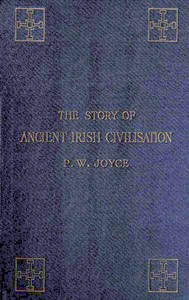
P. W. Joyce opens The Story of Ancient Irish Civilisation with a pointed corrective: the book aims to show that Ireland before the English arrival was not, as many English and Anglo-Irish readers assumed, a 'barbarous and half-savage country.' Joyce, a commissioner for the publication of the Ancient Laws of Ireland, marshals evidence from Brehon law codes, medical manuscripts, and epic tales to portray a society with regulated professions, hereditary learning, and international reputation. The preface quotes Edmund Spenser—'When Ireland flourishèd in fame / Of wealth and goodnesse'—to claim that even a sixteenth-century English poet recognized what later prejudice obscured.
Physicians, Fees, and the Brehon Law
Joyce devotes sustained attention to medicine as a regulated profession. Surgeons accompanied armies with 'a bag full of herbs, ointments, bandages,' and treated friend and foe alike—a practice he traces back two thousand years. The Brehon Law specified fees for each operation, and a physician who through 'carelessness, or wilful neglect, or gross want of skill' failed to cure a wound could be fined the same amount as if he had inflicted it himself. Medical knowledge ran in families—the O'Shiels, O'Cassidys, O'Hickeys, O'Lees—each keeping a hereditary manuscript book in Irish or Latin. Joyce also recounts the legend of Dianket, the Irish god of medicine, whose jealous mixing of herbs supposedly prevented universal cures. The juxtaposition of myth and legal code is characteristic of his method.
Learning, Literacy, and the Missionary Reach
Joyce asserts that in 'education, scholarship, and general mental culture, the Irish of those early ages were in advance of all other countries of Europe.' He credits Irish missionaries and scholars with spreading Christianity and reviving learning on the Continent, and claims that Anglo-Saxon England owed its Christianity and the preservation of learning 'to Irish missionaries and scholars' during Danish raids. The evidence he offers includes the tradition that Josina, a second-century-BC king of Scotland, was educated in Ireland and wrote a treatise on herbs—though Joyce hedges: 'Though we may not quite believe this tradition, it shows that the Irish medical doctors had a reputation abroad for great skill at a very early period.'
Social Order and the Native Law System
The Brehon Law, Joyce argues, underpinned a society with 'clearly defined ranks and grades' and professions 'pervading the whole population.' Physicians attached to a king's household received a residence and tax-free land, plus allowances, and could practice for fee outside. Some 'had castles, and lived in state like princes.' Yet the same law held them accountable: a failed cure meant forfeiting the fee and paying a fine equal to the wound's penalty. Joyce presents this as evidence of a 'steadying and civilising' legal order, comparable to any European system of the period. His tone is consistently defensive—the book is framed as a corrective to ignorance—but the specific legal and medical details ground his argument in documentary evidence.
Joyce's account is shaped by its polemical purpose: to refute the notion that Ireland was barbarous before English rule. Readers should note that the excerpts cover only medicine, law, and missionary activity; the full work includes sections on industry, art, and daily life. Joyce relies heavily on legal texts and legendary material, and his claims about Irish superiority in learning depend on traditions he himself treats cautiously. The book is best read as a early-twentieth-century nationalist corrective, valuable for the specific evidence it assembles rather than for its overarching argument.
That rainy afternoon, Joyce’s Ancient Irish Civilization sat open on my lap, its pages smelling faintly of old paper. I kept returning to his quiet pride about Brehon law’s written permanence. Somewhere between chapters, wondering how any people prove their literacy, my hand drifted to the shelf—and pulled down that older, stranger volume on clay and cuneiform, The discovery and decipherment of the trilingual cuneiform inscriptions — Reading Notes, much as one might reach for tea while lost in thought.