About 641 minutes
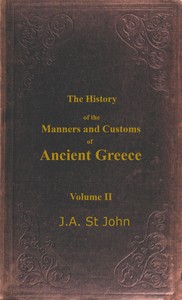
The History of the Manners and Customs of Ancient Greece, Volume 2 (of 3) — Themes and Context
Greece
147,265 recorded words. 4 minutes difference from this book's estimate.
View Gutenberg source #67637
For The History of the Manners and Customs of Ancient Greece, Volume 1 (of 3) — A Reader’s Guide, the stored edition analysis reports 148,261 words, 10 hr 45 min estimated reading time, and 29 detected text sections.
The text analysis averages about 28.5 words per sentence, while the detected sections provide another way to judge how the source is divided.
Project Gutenberg metadata also associates the work with “Greece -- Social life and customs,” connecting these edition facts with the source record’s subject description.
Explore this collection
These alternatives are selected using recorded categories and estimated reading time.
About 641 minutes
Greece
147,265 recorded words. 4 minutes difference from this book's estimate.
View Gutenberg source #67637About 607 minutes
Greece
139,550 recorded words. 38 minutes difference from this book's estimate.
View Gutenberg source #61689About 708 minutes
Greece
162,820 recorded words. 63 minutes difference from this book's estimate.
View Gutenberg source #67707Search stored excerpts and compare books → Choose by your preferences →
Choices use stored catalog measurements. Estimates vary with reading speed. A shared category is a catalog label, not a claim that two books have the same argument or literary quality.
Search reads excerpt text stored with this catalog and links to its associated Gutenberg record. The connection is stored in the site database; this tool does not recheck that every excerpt is word-for-word identical to that external record. Excerpt search does not cover every chapter and does not verify historical publication dates.
Catalog snapshot checked: 2026-09-26. Coverage: 97 public books, 97 available source excerpts.
Calculated from edition completeness, EPUB availability, text structure and catalogue metadata. Not a user rating.
Total of 100 points, scaled to a 2.5-5.0 range. Editions with an empty description or a missing EPUB file are not scored.
Public-domain source text
The source text is kept in the dedicated reader, separate from this catalogue record and its commentary.
J.A. St. John begins his first volume not with a preface on Greece but with a notice on copyright law and a dedication to his son Bayle, acknowledging aid received after a calamity. This framing immediately signals a work shaped by personal circumstance and legal context. The opening chapter then launches into a comparative argument: Greek civilisation arose not from geography but from the race itself, a claim St. John supports with references to lions in Herodotus and dogs in Homer. The excerpts show an author who moves fluidly between ancient texts and modern commentary, often with a wry tone—as when he notes that even in Homeric times, grandees kept “table dogs” valued only for beauty.
The volume opens with a dedication to Bayle St. John, thanking him for “cheerful patience” in completing the work after a calamity. This personal note is unusual for a scholarly history and suggests the author’s circumstances shaped the book’s production. Readers should note that St. John does not dwell on this misfortune; instead, he moves quickly to his subject. The dedication also hints at a collaborative effort, though the extent of Bayle’s contribution is not specified. This opening frames the work as both a personal and intellectual project.
St. John’s prose is dense with classical references, yet he leavens it with dry humour. In discussing hunting, he remarks that Homeric heroes were “arrant poachers” who used nets and gins, and he calls anglers “Isaac Waltons of the ancient world.” He quotes Plato’s disdain for fishing, which Plato “slily classes with piracy and house-breaking.” These asides reveal a writer who expects his audience to recognise both the sources and the wit. The tone is not dryly academic; it is conversational and occasionally ironic, inviting the reader into a shared appreciation of ancient oddities.
The excerpts provide concrete examples of St. John’s method. He cites Herodotus on lions in Acarnania, Homer on the dog Argos, and Athenaeus on fowling. He notes that Patroclus kept nine “table dogs” and that Achilles cast two into his funeral pyre. For fishing, he points to the Odyssey for evidence of sustenance from the sea and the Iliad for oysters procured by diving. These details are not mere decoration; they are the evidence from which St. John builds his case about Greek customs. The reader sees how he weaves together disparate sources to support a broader argument about Greek character.
The excerpts come from early chapters, likely part of a general introduction. St. John’s argument that Greek civilisation was due to racial genius rather than geography sets up a thematic framework. The later sections on hunting, fishing, and fowling illustrate this genius through everyday activities. The volume appears to be organised thematically rather than chronologically, moving from broad claims to specific practices. Readers should expect a work that prioritises interpretation over narrative, with frequent digressions into ancient texts. The footnotes, collected at chapter ends, are essential for tracking sources.
As you read, pay attention to how St. John balances erudition with accessibility. His voice is distinctive: learned but not pedantic, opinionated but grounded in evidence. The excerpts suggest a work that rewards slow reading, with each classical reference inviting further exploration. The footnotes are not mere citations but part of the argument. Approach this volume as a guided tour through ancient Greek life, led by a narrator who is both scholar and storyteller.
That rainy afternoon, St. John’s careful stitching of ancient voices made me feel I was sitting beside him, sifting fragments. The book’s quiet patience stayed with me, and almost by accident I reached for The historians' history of the world in twenty-five volumes, volume 03 — Edition Insights, finding the same gentle hands passing me another thread, another century, still warm.
Answer a few questions and save a private reflection on this device.