About 623 minutes
The discovery and decipherment of the trilingual cuneiform inscriptions — Reading Notes
Ancient Civilizations
143,105 recorded words. 10 minutes difference from this book's estimate.
View Gutenberg source #71905
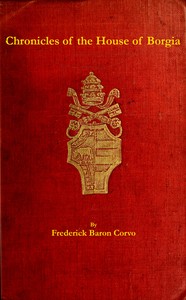
Chronicles of the house of Borgia — Edition Insights can be approached with a clearer sense of reading commitment from its source measurements: 140,809 words, 10 hr 13 min estimated reading time, and 23 detected text sections.
The text analysis averages about 23.1 words per sentence, while the detected sections provide another way to judge how the source is divided.
Project Gutenberg metadata also associates the work with “Italy -- History -- 1492-1559,” connecting these edition facts with the source record’s subject description.
Explore this collection
These alternatives are selected using recorded categories and estimated reading time.
About 623 minutes
Ancient Civilizations
143,105 recorded words. 10 minutes difference from this book's estimate.
View Gutenberg source #71905About 633 minutes
Ancient Civilizations
145,505 recorded words. 20 minutes difference from this book's estimate.
View Gutenberg source #39848About 568 minutes
Ancient Civilizations
130,426 recorded words. 45 minutes difference from this book's estimate.
View Gutenberg source #52406Search stored excerpts and compare books → Choose by your preferences →
Choices use stored catalog measurements. Estimates vary with reading speed. A shared category is a catalog label, not a claim that two books have the same argument or literary quality.
Search reads excerpt text stored with this catalog and links to its associated Gutenberg record. The connection is stored in the site database; this tool does not recheck that every excerpt is word-for-word identical to that external record. Excerpt search does not cover every chapter and does not verify historical publication dates.
Catalog snapshot checked: 2026-09-26. Coverage: 97 public books, 97 available source excerpts.
Calculated from edition completeness, EPUB availability, text structure and catalogue metadata. Not a user rating.
Total of 100 points, scaled to a 2.5-5.0 range. Editions with an empty description or a missing EPUB file are not scored.
Public-domain source text
The source text is kept in the dedicated reader, separate from this catalogue record and its commentary.
Frederick Rolfe, writing under the name Baron Corvo, opens his 'Chronicles of the House of Borgia' with a preface that frames the rise and fall of great families as a natural cycle: 'They shoot, bud, bloom, bear fruit;—from obscurity they rise to dominate their Age.' The book then plunges into detailed episodes, such as the execution of Messer Ramiro d'Orco, where Rolfe emphasizes Duke Cesare's use of 'the sense of sight' to display power. The narrative is punctuated by epigraphs from Caxton and Boccaccio, signaling a literary ambition that blends historical chronicle with moral reflection.
One of the most striking passages describes the Christmas Day execution of Ramiro d'Orco in Cesena. Rolfe presents the scene with deliberate visual clarity: 'a glittering axe, fixed in a block upon the snow,' a headless body in rich garments, and the bodiless head on a pike. He notes that 'all chroniclers of the period congratulate Duke Cesare,' and cites Machiavelli's remark that the Duke 'was pleased to shew that he had the power to make men—and to mar them.' Rolfe interprets this as a lesson in political theater: 'Duke Cesare in teaching made use of the sense of sight.' The passage reveals Rolfe's method—he weaves together primary sources, dramatic description, and interpretive commentary, treating the historical record as both evidence and spectacle.
Rolfe's account of the capture of the conspirators at Sinigaglia on New Year's Eve 1502 is another set piece. He details the arrival of Duke Cesare, the deployment of troops, and the deceptive cordiality with which the Duke greeted the Orsini and Vitelli. Rolfe notes that Machiavelli, then a Florentine envoy, arrived later to find the city in chaos, and reports the Duke's words: 'I have had a chance, and I have taken it.' This episode showcases Rolfe's reliance on contemporary witnesses and his interest in the mechanics of betrayal. The narrative is dense with proper names and tactical details, reflecting a close reading of sources like Machiavelli's 'Descrizione del modo tenuto dal Duca Valentino nello ammazzare Vitellozzo Vitelli,' though Rolfe does not cite it explicitly in the excerpt.
Rolfe frames his chronicle with epigraphs from William Caxton and Giovanni Boccaccio. The Caxton quotation, in Middle English, warns the book to avoid envy and keep itself from harm. The Boccaccio passage, in Italian, is a harsh indictment of the clergy from the Decameron, describing the Roman Curia as 'a forge of diabolical operations' rather than divine. These choices signal Rolfe's own moral stance: he presents the Borgia story as a cautionary tale about corruption, yet he also aligns himself with earlier writers who used historical narrative to critique power. The epigraphs also hint at Rolfe's literary pretensions—he is not merely a historian but a stylist, invoking the authority of past authors to legitimize his own work.
Readers approaching Rolfe's chronicle should be prepared for a work that is as much about the author's voice as about the Borgias. The narrative is dense with names and events, but Rolfe's moralizing tone and dramatic set pieces give it a distinctive character. Those interested in the intersection of history and literature, or in the reception of the Borgia legend, will find much to analyze. The excerpts suggest a book that rewards careful reading, especially for its use of sources and its theatrical presentation of power.
Reading about the Borgias felt less like history and more like sitting with someone’s heavy memory. That same quiet weight lingers in Man and the Glacial Period — Themes and Context, where time itself becomes the slow, unblinking witness. I keep thinking how both books leave you aware of ice—whether beneath power or beneath centuries. A strange, cold comfort, but a real one.
Answer a few questions and save a private reflection on this device.