About 438 minutes
Manners and Monuments of Prehistoric Peoples — Key Ideas to Explore
Ancient Civilizations
100,660 recorded words. 27 minutes difference from this book's estimate.
View Gutenberg source #3309
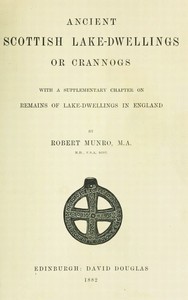
The catalog record for Ancient Scottish Lake-Dwellings or Crannogs With a supplementary chapter on remains of lake-dwellings in England — Text and Context provides practical reading context through 94,382 words, 6 hr 51 min estimated reading time, and 13 detected text sections.
The text analysis averages about 18.3 words per sentence, while the detected sections provide another way to judge how the source is divided.
Project Gutenberg metadata also associates the work with “Scotland -- Antiquities,” connecting these edition facts with the source record’s subject description.
Explore this collection
These alternatives are selected using recorded categories and estimated reading time.
About 438 minutes
Ancient Civilizations
100,660 recorded words. 27 minutes difference from this book's estimate.
View Gutenberg source #3309About 384 minutes
Ancient Civilizations
88,304 recorded words. 27 minutes difference from this book's estimate.
View Gutenberg source #20055About 383 minutes
Ancient Civilizations
88,075 recorded words. 28 minutes difference from this book's estimate.
View Gutenberg source #1705Search stored excerpts and compare books → Choose by your preferences →
Choices use stored catalog measurements. Estimates vary with reading speed. A shared category is a catalog label, not a claim that two books have the same argument or literary quality.
Search reads excerpt text stored with this catalog and links to its associated Gutenberg record. The connection is stored in the site database; this tool does not recheck that every excerpt is word-for-word identical to that external record. Excerpt search does not cover every chapter and does not verify historical publication dates.
Catalog snapshot checked: 2026-09-26. Coverage: 97 public books, 97 available source excerpts.
Calculated from edition completeness, EPUB availability, text structure and catalogue metadata. Not a user rating.
Total of 100 points, scaled to a 2.5-5.0 range. Editions with an empty description or a missing EPUB file are not scored.
Public-domain source text
The source text is kept in the dedicated reader, separate from this catalogue record and its commentary.
Robert Munro's Ancient Scottish Lake-Dwellings or Crannogs (1882) opens with a striking authorial choice: rather than paraphrasing earlier observers, Munro retains their exact words, creating a layered documentary record. He explains that his principal work in compiling the historical chapter was selecting from old literature 'such portions as could be fairly construed to indicate the former existence of ancient lacustrine abodes.' This method lets the reader encounter the raw observations—sometimes vague or misunderstood by the original writers—alongside Munro's own interpretive framework.
The book's core is a series of excavation reports from the 1870s, notably at Lochspouts and other Ayrshire sites. Munro's prose is relentlessly empirical: he records dimensions, stratigraphy, and artifact positions with the precision of a field notebook. A typical passage notes 'a layer of rough, large stones, marked B on Plate III., about 15 feet long from north to south, and 11 feet broad,' followed by the discovery of a 'spade-shaped platform' and multiple superimposed log floors. This granular detail, coupled with Munro's reluctance to speculate beyond the evidence, gives the work a distinctive voice—that of a busy professional archaeologist writing in 'scraps of time.'
Munro's decision to quote earlier writers verbatim shapes the book's texture. In Chapter II, he assembles passages from antiquaries who described wooden piles and artificial islands without fully understanding them. By preserving their exact phrasing—'the exact words of the original narrators'—Munro lets readers gauge the evolution of archaeological interpretation. For instance, a 17th-century observer might note 'a great number of oaken stakes' without recognizing them as part of a crannog. Munro then adds his own commentary, bridging the gap between raw description and modern inference. This technique avoids the homogenization of a single narrative voice and instead presents a mosaic of perspectives, from early travelers to 19th-century excavators. The result is a work that feels collaborative across centuries, even as Munro's editorial hand selects and arranges the material.
The excavation descriptions are the book's most distinctive feature. Munro records not just what was found, but the precise order of deposits. At one hearth, he notes a descending series: 'Rough stones, 9 inches. Peat, 12 inches. Ashes, 5 inches. White clay, 3 or 4 inches. Ashes.' This stratigraphic list reads almost like a poem of debris. He also documents the condition of materials—'some of the logs had rotted away, and others were pierced through by the shoots of the marsh plants'—and the challenges of wet excavation: 'The influx of water prevented further examination.' Small finds are described with similar care: a 'long rude whetstone,' a 'hammer-stone of water-rolled quartzite pebble,' and a fragment of 'smoothly-worked wood, 3 inches long, 2 broad, and 1/2 an inch thick, which may have been part of a ladle or large spoon.' Munro does not inflate their significance; he lets the objects speak through their dimensions and context.
Munro's descriptions of crannog structures are remarkably concrete. He notes the arrangement of piles—'more thinly set' at gaps—and the presence of multiple log floors stacked vertically. At one location, excavators found 'a floor of oak logs, laid north and south, 10 feet 6 inches in length and 8 feet in breadth,' with interstices 'closely packed with white clay and the sphagnum moss.' Below this lay a second floor 'the parts of which were sloping,' and beneath that a square oak frame with 'two square-cut mortise holes, measuring 6 by 5 inches.' The precision of these measurements—down to half-inches—reflects Munro's archaeological rigor. He also records the positions of hearths relative to these structures: 'a circular hearth of rough stones bedded in clay' near the frame, and another beyond the northwest angle. The presence of 'several inches in depth of ashes, with charred wood, and fragments of bone too small and wasted to indicate what animal they belonged to' adds a human dimension without overstatement.
The final chapter extends the survey to England, but Munro's approach remains consistent: he collates reports from sites like those in the East Anglian fens, again prioritizing original accounts. The tone is comparative but cautious; Munro notes similarities in construction—'piles, floors, and hearths'—but avoids sweeping claims about cultural diffusion. He acknowledges the limitations of the evidence: many English sites were less systematically excavated than their Scottish counterparts. This chapter serves as a coda, reinforcing the book's documentary ethos. Munro does not attempt a grand synthesis; instead, he presents the English material as a 'supplementary' record, leaving readers to draw their own connections. The effect is to underscore the provisional nature of archaeological knowledge in the 1880s—a theme that runs throughout the work.
Munro's Ancient Scottish Lake-Dwellings rewards readers who attend to its details. The book is less a narrative than a collection of evidence, arranged with a clear editorial hand. To read it is to watch an archaeologist at work: measuring, recording, and selecting from a mass of earlier literature. The result is a valuable primary source for understanding both crannogs and the development of archaeological method in the late 19th century. Approach it as a field report rather than a synthesis, and its quiet authority becomes apparent.
Sometimes a book settles beside another on the shelf, and you feel a quiet kinship. Munro’s crannogs speak of people building fragile homes upon water, seeking safety in a shifting world. It reminds me of The Condition of Catholics Under James I. Father Gerard's Narrative of the Gunpowder Plot — Background and Themes, another story of faith making do in dangerous times. Both are records of survival, patiently preserved.
Save your reaction, strongest insight, and memorable passage.