
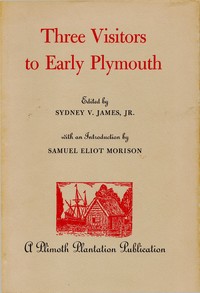
Three Visitors to Early Plymouth by Altham, Pory, and Rasieres
Forget the simplified Thanksgiving pageant version of Plymouth. 'Three Visitors to Early Plymouth' throws the door wide open on the colony's chaotic early days. Edited from the letters and reports of Emmanuel Altham, John Pory, and Isaack de Rasieres, this book is a collection of snapshots. These men weren't settlers; they were outsiders—a merchant looking for profit, a government official on a fact-finding mission, and a soldier-diplomat from a rival Dutch colony. They arrived between 1623 and 1627, saw what they saw, and wrote it all down for their bosses back home.
The Story
There isn't one plot, but three overlapping tours. You walk with Altham as he describes the fort, the houses, and the precarious food supply. You sit with John Pory as he records the political tensions and the colonists' dealings with local Indigenous leaders. Then, you get the view from Isaack de Rasieres, who provides incredibly detailed notes on everything from what people wore to how they traded. The 'story' is the colony itself, seen through three different pairs of eyes. You see the gap between the settlers' ideals and their gritty reality, and you get a real sense of how fragile and strange this whole experiment was.
Why You Should Read It
This book is a masterclass in point of view. History often gets flattened into one official story, but here you have to juggle three. It makes you an active reader, comparing accounts and questioning biases. Was the harvest bountiful or meager? Were the Pilgrims noble or struggling? The answer is usually 'both,' depending on who you ask. I loved the mundane details most: lists of trade goods, descriptions of a meal, notes on construction. These details do more to bring 1620s Plymouth to life than any textbook summary ever could. It feels immediate and real.
Final Verdict
Perfect for history fans who are tired of the broad strokes and want the close-up, personal view. If you enjoyed books like Mayflower by Nathaniel Philbrick but wanted more raw source material, this is your next read. It's also great for anyone who loves primary sources—it's like a curated museum exhibit of letters. Fair warning: it's not a novel. It requires a bit of patience as you switch between voices. But the reward is a richer, more complicated, and far more interesting portrait of American beginnings. You won't look at Plymouth Rock the same way again.
This book is widely considered to be in the public domain. Access is open to everyone around the world.
Susan Lee
4 weeks agoInitially, I was looking for a specific answer, but the structural organization allows for quick referencing of key points. This exceeded my expectations in almost every way.
Donald Anderson
6 months agoI appreciate how this edition approaches the core problem, the breakdown of complex theories into digestible segments is masterfully done. I am looking forward to the author's next publication.
Patricia Rodriguez
1 year agoAs a long-time follower of this subject matter, the chapter on advanced strategies offers insights I haven't seen elsewhere. I appreciate the effort that went into this curation.
Matthew Garcia
1 month agoThis work demonstrates a clear mastery of contemporary theories.

Jennifer Johnson
1 year agoI particularly value the technical accuracy maintained throughout.