
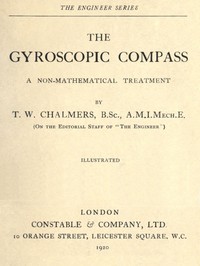
The Gyroscopic Compass: A Non-Mathematical Treatment by T. W. Chalmers
Published in 1918, The Gyroscopic Compass by T.W. Chalmers is not a novel, but it tells a crucial story. It's the story of a technological revolution at sea. Before this device, magnetic compasses were easily confused by a ship's own iron, leading to dangerous errors. The gyrocompass, using the unchanging spin of a wheel, promised true north, always.
The Story
Chalmers doesn't just describe the machine; he builds your understanding from the ground up. He starts with the basic behavior of a spinning top, something you might have played with as a kid. Then, layer by layer, he shows how enclosing that top in a set of gimbals and harnessing the Earth's rotation turns a toy into a lifesaving navigational instrument. He guides you through why it seeks north, how it corrects itself, and why it's immune to the metal of the ship. The 'plot' is your own journey from simple curiosity to genuine comprehension of a mechanical marvel.
Why You Should Read It
What makes this book special is Chalmers's voice. He was clearly a teacher at heart. His goal isn't to show off his knowledge but to share it. Reading it feels like having a patient, brilliant uncle explain a fascinating concept at the kitchen table. You get a real sense of the wonder people felt when this technology was new. It's a snapshot of a time when engineering elegance was a form of magic, made understandable. It’s also a lesson in clear communication—proof that you don't need complex math to explain complex ideas, just clear thinking and good metaphors.
Final Verdict
This is a perfect read for the naturally curious—the kind of person who takes things apart to see how they work. It's great for history fans interested in early 20th-century tech, sailing enthusiasts, or anyone who enjoys well-explained science. If you liked books like The Perfectionists by Simon Winchester or get a kick out of YouTube channels like Technology Connections, you'll find a kindred spirit in T.W. Chalmers. It's a short, satisfying trip into the mind of an engineer from a century ago, and the clever device that helped steer the modern world.
This content is free to share and distribute. It serves as a testament to our shared literary heritage.
Linda Gonzalez
9 months agoThis was exactly the kind of deep dive I was searching for, the cross-referencing of different chapters makes it a great study tool. Definitely a five-star contribution to the field.
James Hernandez
2 months agoI found the data interpretation to be highly professional and unbiased.
George White
7 months agoBefore I started my latest project, I read this and the formatting on mobile devices is surprisingly crisp and clear. It’s hard to find this much value in a single source these days.
Ashley Miller
5 months agoHaving read the author's previous works, the case studies and practical examples provided add immense value. A refreshing and intellectually stimulating read.






John Harris
3 months agoFrom a researcher's perspective, the data points used to support the main thesis are quite robust. Simple, effective, and authoritative – what else could you ask for?