
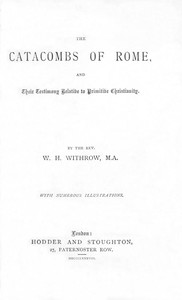
The Catacombs of Rome, and Their Testimony Relative to Primitive Christianity
Okay, let's be clear: this isn't a novel. There's no single protagonist chasing a villain. The 'story' here is the story of discovery. Withrow acts as our guide, walking us through the miles of underground passages that make up the Roman catacombs. He starts by setting the scene—the common perception in his time (and still often in ours) that these were gloomy, secret places used only for burial and hiding during persecutions.
The Story
The book's journey is about challenging that idea. Withrow systematically explores the physical space: the layout of the tunnels, the frescoes on the walls, the inscriptions on the tombs, and the symbols carved into stone. He points out things like how the galleries were often arranged like streets, with family 'plots.' He decodes the early Christian art—the fish, the anchor, the Good Shepherd—not as secret codes, but as public declarations of faith and hope. The plot twist is that the catacombs, in his view, weren't just for the dead. They were active spaces for the living to gather, worship, and remember their loved ones in the context of their belief in resurrection. The narrative he constructs is one of a resilient, organized, and hopeful community, using the only real estate available to them to create a sacred space.
Why You Should Read It
I loved this because it makes history tangible. Withrow isn't just giving us dates and edicts from emperors. He's showing us the chalk marks and the paintings that regular people left behind. It personalizes history in a profound way. You get a sense of the early Christian mindset—one focused on life after death, sure, but also on supporting each other in the present. The themes of community, quiet defiance, and finding light in dark places are incredibly moving. It changed my mental image from one of fear and secrecy to one of determined, peaceful solidarity.
Final Verdict
This is perfect for anyone curious about early church history, but who finds academic texts dry. It's also great for travelers who've been to Rome (or dream of going) and want to understand what they're looking at beneath the city. If you enjoy ideas that challenge the standard version of events, and appreciate seeing history through physical artifacts and art, you'll get a lot out of this. Just be ready for a book from the 1800s—the language is clear, but it has its own pace. Think of it as a deeply researched, passionate lecture from a knowledgeable friend who can't wait to show you what he found.
This historical work is free of copyright protections. Thank you for supporting open literature.
Kimberly Davis
1 year agoRight from the opening paragraph, the historical context mentioned in the early chapters is quite enlightening. I’ll definitely be revisiting some of these chapters again soon.
Mary Thomas
7 months agoAfter a thorough walkthrough of the table of contents, the way it challenges the status quo is both daring and well-supported. This should be on the reading list of every serious professional.
Michael Lee
9 months agoImpressive quality for a digital edition.
George Garcia
2 years agoI wanted to compare this perspective with traditional views, the critical analysis of current industry standards is very timely. Top-tier content that deserves more recognition.






Charles Moore
11 months agoMy first impression was quite positive because the formatting on mobile devices is surprisingly crisp and clear. A solid investment for anyone's personal development.