
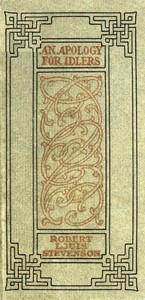
An apology for idlers, and other essays by Robert Louis Stevenson
This isn't a novel with a plot, but a collection of Stevenson's thoughts on life, travel, and character. The title essay, 'An Apology for Idlers,' is the star. In it, Stevenson pushes back hard against the Victorian-era (and very familiar) obsession with constant work and self-improvement. He champions the loiterer, the dreamer, the person who spends an afternoon watching clouds instead of checking tasks off a list. The other essays wander through similar territory—pondering the value of walking tours, the quirks of human nature, and the quiet joys we often miss when we're too focused on goals.
Why You Should Read It
I picked this up on a day I was feeling completely overwhelmed, and it was like a cool glass of water. Stevenson's writing is so clear and charming, it feels like you're having a conversation with a very clever, kind friend. He's not promoting laziness in a destructive way. Instead, he's asking us to think about what we're so busy for. Are we living, or just ticking boxes? His argument that some of our best thoughts and truest education come from unstructured time really hit home. In our world of notifications and side hustles, his 19th-century wisdom feels like a radical act of resistance. It made me look at my own schedule differently and gave me the courage to protect some empty space in my week.
Final Verdict
This book is perfect for anyone feeling the pressure of modern productivity culture, lovers of thoughtful, elegant prose, and fans of classic writers who sound utterly contemporary. If you enjoy the essays of people like G.K. Chesterton or even modern writers like Oliver Burkeman, you'll find a kindred spirit in Stevenson. It's a short, soothing read that packs a powerful punch—a reminder that sometimes, the most productive thing you can do is absolutely nothing at all.
This is a copyright-free edition. Access is open to everyone around the world.
Jennifer Brown
1 year agoExactly what I was looking for, thanks!
David Williams
2 weeks agoI've gone through the entire material twice now, and the author manages to bridge the gap between theory and practice effectively. If you want to master this topic, start right here.
Karen Smith
4 months agoAfter spending a few days with this digital edition, the insights into future trends are particularly thought-provoking. The insights gained here are worth every minute of reading.
Barbara Davis
2 years agoOne of the most comprehensive guides I've read this year.



Donald Smith
5 months agoFrom a researcher's perspective, the attention to detail regarding the core terminology is flawless. I am looking forward to the author's next publication.